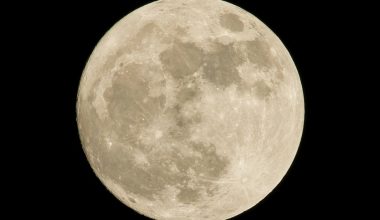
Festival is similar to Thanksgiving and dates back thousands of years, according to Joyce Crawford. Harvest, families, children and moon viewing are all represented by the night of a full moon during the Chinese New Year.
Crawford said the festival is a time for family and friends to come together and celebrate with food, music, dancing, games, crafts and more. S it is also an opportunity for people to get to know each other and learn more about the Asian community.
Table of Contents
Why do people celebrate harvest moon?
The main significance of the Harvest Moon is rooted in the days when farmers had to make haste to finish gathering crops in the fields. They were aided by the Harvest Moon, which has a shorter rising time between sunset and when it makes an appearance in the Eastern skies, making it easier for farmers to harvest their crops.
It is also important to note that the moon is not the only thing that influences the seasons. The seasons are influenced by many other factors, such as the sun’s position in relation to the Earth’s axis of rotation, the length of daylight hours, and the amount of sunlight that reaches the earth’s surface.
What do mooncakes symbolize?
Mooncakes symbolize family reunion in chinese culture. A full moon is a sign of prosperity for the family. The round mooncake is a traditional Chinese dessert. It is made by rolling the dough into a round shape and then baking it in a preheated oven. Chinese lunar calendar is based on the Gregorian calendar, which was introduced in 1582 by the French astronomer Jean-Baptiste Léopold Trouvelot.
China, the year is divided into 12 months, each of which has a lunar month and a solar month. Lunar months begin on January 1 and end on December 31, while solar months start on March 21 and last until the end of March.
Each month has its own moon phase, and the moon’s position in relation to the Earth’s axis of rotation is known as the zodiacal point. For example, in January the Moon is at its closest point to Earth, called the apogee, or point of greatest elongation. This is the point at which it is farthest from the Sun.
When should you eat mooncakes?
Mooncakes are eaten after dinner while admiring the moon, but the festival is also celebrated by the chinese in other ways. People decorate their streets, homes, and businesses with lanterns, which are usually handmade with paper, though bulb-lit ones are also popular.
Is thanksgiving the same as harvest festival?
A harvest festival, also Thanksgiving, is an annual celebration that occurs around the time of the main harvest of a given region.
The food that is drawn from the crops that come to maturity around the time the festival is held is typically a feast for both the family and the public. Thanksgiving is celebrated on the fourth Thursday of November.
Canada, it is the second Thursday in November, and in Mexico, the third Thursday.
Is harvest festival a religious festival?
During the month of September, we celebrate this day by singing, praying and decorating our churches with baskets of fruit and food in a festival known as the ‘Harvest Festival’. Christians of the Lord’s Supper, which is celebrated on the first Sunday after the Feast of Tabernacles (Septuagint).
Jesus is said to have said, “The Son of Man is going to come in his Father’s glory with his angels, and then he will reward each person according to what they have done” (Matthew 28:19-20). This is a reference to the harvest festival, in which people gather to eat, drink and be merry. The word “unavenged” means “without blemish” or “clean” in Hebrew.
What country eats moon cakes?
During the mid-autumn festival, a chinese bakery product is traditionally eaten. Moons are seen as a sign of good luck and prosperity during the festival. Mooncakes have a long history in China, dating back to the Ming Dynasty (1368-1644) when they were made with rice flour and sugar.
Mooncakes were popularized in the United States during World War II, when the U.S. military used them to celebrate the end of the war. War (1950-53) and the Vietnam War, the cake was used as an anti-communist propaganda tool. The cake is still popular today in many parts of Asia, especially in Vietnam and Cambodia.